The environment of the medical office or clinic contributes almost as much to a patient's well-being as does the medical attention given by the physician and medical assistants. The physical environment can foster a feeling that embraces and welcomes patients or causes them to feel alienated and intimidated. Interior designers and experts in space planning are advising all individuals involved in designing clinics, medical offices, and hospitals that patient comfort must be considered as important as the facility's functional utility and ease of maintenance. The Americans with Disabilities Act (ADA) also must be taken into account when creating any medical office environment, and provisions must be made to accommodate patients who are physically challenged. The creation of a health care facility involves many variables. Some are concrete elements, such as lighting, color choice, and furniture arrangement. Yet others are intangible and are expressed in a receptionist's greeting and attitude toward patients. Together, these elements make an ambulatory setting the kind of environment where patients will feel comfortable and secure.
The Reception Area:
A reception area is just thata place of reception; it should never be thought of as the waiting room. This is the area that can make the patient feel welcome, secure, and comfortable. Adequate and comfortable seating affords patients room to have their own space. Proper seating placement also respects cultural biases. For example, some Americans do not like to be touched by strangers. Middle Eastern and Latin cultures, by contrast, encourage closeness and touching, and individuals from these cultures may cluster themselves close together in the reception area. Current magazines that are appropriate to the clinic clientele, plants, and other features such as a professionally maintained built-in aquarium will help set a welcoming tone. The fabric and texture of draperies, upholstery, and carpet should be pleasing, comfortable, and easy to maintain. It is helpful if there is a place for patients to hang heavy coats or wet umbrellas. Many physicians provide educational materials for patients in the reception area. For example, new parents always appreciate pamphlets related to raising children. It is also appropriate to have available in the reception area a patient information brochure that describes the services of the office, the function of medical staff members, measures to take in case of an emergency, and other issues that patients may need to consider.
Facility Environment And Reception Area
Goal Setting For Medical Assistants
Discoveries prove that goal-oriented employees are more effective and assertive than colleagues with no goals or future objectives. Recognizing the value of goal planning, many employers arrange planning sessions and/or seminars to encourage goal setting as a practical application for coping with stress and the development of career objectives. If this does not happen in your work environment, seek your own seminars for goal setting. Such an activity not only "centers" you in your current employment but helps you clearly picture your future plans and hopes.
What is a goal? The dictionary definition of a goal according to Websters Collegiate Dictionary is, "the result or achievement toward which effort is directed." In order to reach a desired goal, a person must implement planning along with a sincere desire to work hard. Skill in goal setting allows the medical assistant to clarify what must be accomplished and to develop a strategic plan to successfully achieve the goal. A goal must be specific, challenging, realistic, attainable, and measurable. Specific goals are focused and have very precise boundaries. A goal that is challenging creates enthusiasm and interest in achievement. Realistic goals are practical or beneficial for the present and for future self-actualization. An attainable goal refers to the fact that the goal is possible to fulfill. Measurable goals achieve some form of progress or success. By reflecting back on the process, one is encouraged to establish additional goals.
Long-range goals are achievements that may take three to five years to accomplish. Long-range goals give direction and definition to our lives and serve to keep us "on track" so to speak. Much discipline, perseverance, determination, and hard work will be expended in accomplishing long-range goals. Some adjustment and readjustment to your goals may be necessary, however. The rewards of goal achievement include satisfaction, pride, a sense of accomplishment, and a job well done.
Short-range goals take apart long-range goals and reassemble the required activities into smaller, more manageable time segments. The time segments may be daily, weekly, monthly, quarterly, or yearly periods.
As a graduate and new employee, one of your long-range goals might be to become the office manager in the ambulatory care setting in which you are currently employed. You may wish to attain this goal within the next three to five years; by breaking it into three longer range goals and a series of short-range goals, you will be able to measure progress and feel a sense of accomplishment. Examples of long- and short-range goals might include:
Long-range goal #1:
To become proficient in all back-office clinical skills during the first year of employment!
Short-range goals necessary to achieve this goal # 1:
a) Practice accuracy and proficiency when performing tasks and skills.
b) Practice efficiency by planning ahead for the equipment and supplies needed for each task performed.
c) Evaluate your progress on a regular basis and identify areas that need improvement.
Long-range goal #2:
To add front-office administrative tasks and skills to your routine during the second year of employment.
Short-range goals necessary to achieve this:
a) Practice accuracy and proficiency when performing all front-office tasks and skills.
b) Practice efficiency by planning ahead for the equipment and supplies needed for each task performed.
c) Evaluate your progress on a regular basis and identify areas that need improvement.
Long-range goal #3:
To begin to focus on office management during the third year of employment.
Short-range goals necessary to achieve this:
a) Develop a procedures manual for all back- and front-office tasks and skills.
b) Enroll in office management classes.
c) Focus on team-building skills.
By year four, you will be ready to move into the office manager position.
Long-range and short-range goals work together to help make changes in our lives. Goals keep life interesting and give us something to strive for. We can all reach goals successfully with some planning, hard work, discipline, and dedication.
Physical Attributes Of Medical Assistants
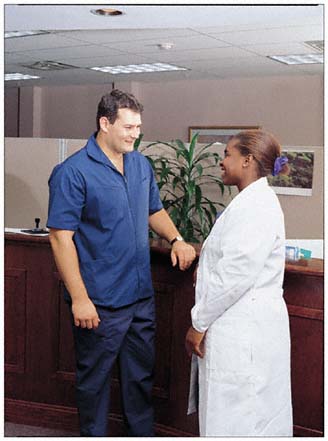
As a good and caring medical assistant, appearance is important in patients' perceptions of the delivery of their care. Imparting the look of a professional requires an appearance that is clean and fresh and wholesome; in general, an appearance that reflects good health habits, Figure 1-2. Good personal hygiene practices, weight control, healthy-looking skin, hair, teeth, and nails all contribute to a professional appearance. Rest, good nutrition, regular exercise, and recreation all promote good health.
Female medical assistants should wear appropriate light daytime makeup. For the safety of both the professional and the patient, no necklaces or dangling earrings should be worn. The only jewelry worn should be ear-posts or wedding rings. Hair should be neat and off the collar. Wear only clear, unchipped nail polish. Male medical assistants should be clean-shaven and have short hair. The only jewelry should be a wedding ring. Colognes, perfumes, and after-shave should not be worn at work.
Patient care can place physical demands upon medical assistants. Lifting and moving patients is often required and the use of correct body mechanics will help minimize injuries to the back. While every reasonable accommodation is made for physically challenged medical assistants, to be mobile without assistance is important because medical assistants will move about throughout the day while performing tasks and procedures. It is frequently necessary to bend, stoop, kneel, and crouch, especially when filing and retrieving patients' records, and for other tasks as well. Most procedures require that medical assistants have the ability to hear and see well for the accurate completion of tasks. Listening to blood pressures, taking a medical history, observing patients, performing phlebotomy, and identifying microorganisms under a microscope are some of the routine tasks and procedures performed daily in a medical facility. Manual dexterity is also needed for manipulating certain instruments and for entering data using a computer.
It is important that medical assistants learn to develop the ability to communicate well verbally and non verbally with patients during their jobs. Compliance with the physician's treatment plan is important for a positive outcome of patients' illnesses patients will feel more comfortable and less threatened in a medical office or ambulatory center that encourages staff to keep them informed.
Personal Attributes of Medical Assistant

Today I am going to write briefly about the personal attributes of a medical assistant..
Consider the following points which will certainly help you to provide patients with the best health care possible and learn what it means to be a professional medical assistant!
1) Empathy
To have empathy means to consider the patient's welfare and to be kind. It means stepping into the patient's place, discovering what the patient is experiencing, and then recognizing and identifying with those feelings. Medical assistants should treat patients as they would want to be treated. A visit to the doctor is often a time of fear and anxiety.
Apprehension can be allayed tremendously when patients realize that their health care provider understands their feelings and desires to make their lives more pleasant and comfortable.
2) Attitude
A friendly, warm disposition and a sense of humor will help patients feel more at ease. A sincere affection for people can be conveyed by actions that facilitate open and honest communication. An attitude should radiate genuine interest. On occasion, difficult patients can test the tolerance level of the most experienced medical assistant because they seem never to be content with the care or services received. But no matter what the circumstances, patients should never be treated with disinterest or in an unfriendly manner. The medical assistant should always be pleasant and courteous.
3) Dependability
Being dependable means that employer and co-workers rely on the medical assistant to be respectful of them, of patients, and of equipment and materials. Other members of the health care team will expect duties and responsibilities to be carried out responsibly. A dependable person interacts with coworkers in a supportive manner, is punctual, and limits absences from work.
4) Initiative
The willingness and ability to work independently shows initiative. A person with initiative is observant, notices work that needs to be done, and then takes action to complete those tasks without being told. Employer and coworkers must be able to count on one another to anticipate patients' needs and be attentive to work that needs to be accomplished. The successful medical assistant will be ready to pitch in and recognize when others need assistance.
5) Flexibility
The ability to be adaptable is a trait that serves all professionals well. When caring for ill people, unexpected situations arise daily and medical assistants must be able to respond to a variety of situations (many of them emergencies and unanticipated) without losing a sense of equilibrium. To improvise, or solve problems that arise either routinely or spontaneously, is a characteristic worth nurturing.
6) Desire to Learn
A willingness to continually learn and grow is the mark of a true professional. With the multitude of new technology in medicine, there is an ongoing necessity for constant learning. Medical assistants must be dedicated to high standards of performance, which can be accomplished by showing a desire to acquire information and by constantly updating their knowledge and skills. Keeping abreast of the latest diseases, treatments, procedures, and techniques can be achieved in a variety of ways, such as college courses, seminars, workshops, reading, and simply by being observant. The sharper the power of observation, the more the medical assistant will learn from physician, employer, and coworkers.